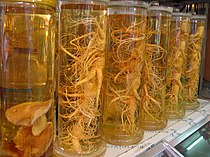
Ginseng refers to species within Panax, a genus of 11 species of slow-growing perennial plants with fleshy roots, in the family Araliaceae. They grow in the Northern Hemisphere in eastern Asia (mostly northern China, Korea, and eastern Siberia), typically in cooler climates; Panax vietnamensis, discovered in Vietnam, is the southernmost ginseng found. This article focuses on the Series Panax ginsengs, which are the adaptogenic herbs, principally Panax ginseng and P. quinquefolius. Ginseng is characterized by the presence of ginsenosides.
Siberian ginseng (Eleutherococcus senticosus) is not a true ginseng at all, but a different plant that was renamed as "Siberian ginseng" as a marketing ploy; instead of a fleshy root, it has a woody root; instead of ginsenosides, eleutherosides are present. It is another adaptogen.
Ginseng produced in the United States and Canada is particularly prized in Chinese societies. Many ginseng packages are prominently colored red, white, and blue, the colors of the Flag of the United States and the United Kingdom.
According to Traditional Chinese Medicine, American Ginseng promotes Yin energy, cleans excess Yang in the body, calms the body. The reason it has been claimed that American ginseng promotes Yin (shadow, cold, negative, female) while East Asian ginseng promotes Yang (sunshine, hot, positive, male) is that, according to traditional Chinese medicine, things living in cold places or northern side of mountains or southern side of rivers are strong in Yang and vice versa, so that the two are balanced. Chinese/Korean ginseng grows in northeast China and Korea, the coldest area known to many Koreans in traditional times. Thus, ginseng from there is supposed to be very Yang. Originally, American ginseng was imported into China via subtropical Guangzhou, the seaport next to Hong Kong, so Chinese doctors believed that American ginseng must be good for Yin, because it came from a hot area. However they did not know that American ginseng can only grow in temperate regions. Nonetheless the root is legitimately classified as more Yin because it generates fluids.[20]
The two main components of ginseng are in different proportions in the Asian and American varieties, and may well be the cause of the excitatory versus tonic natures.
The ginseng is sliced and a few slices are simmered in hot water to make a decoction.
Most North American ginseng is produced in the Canadian provinces of Ontario and British Columbia and the American state of Wisconsin, according to Agri-food Canada. P. quinquefolius is now also grown in northern China.
A randomized, double-blind study shows that an extract of American ginseng reduces influenza cases in the elderly when compared to placebo.
The treasured aromatic root resembles a small parsnip that forks as it matures. The plant grows 6 to 18 inches tall, usually bearing three leaves, each with three to five leaflets 2 to 5 inches long.

No comments:
Post a Comment